
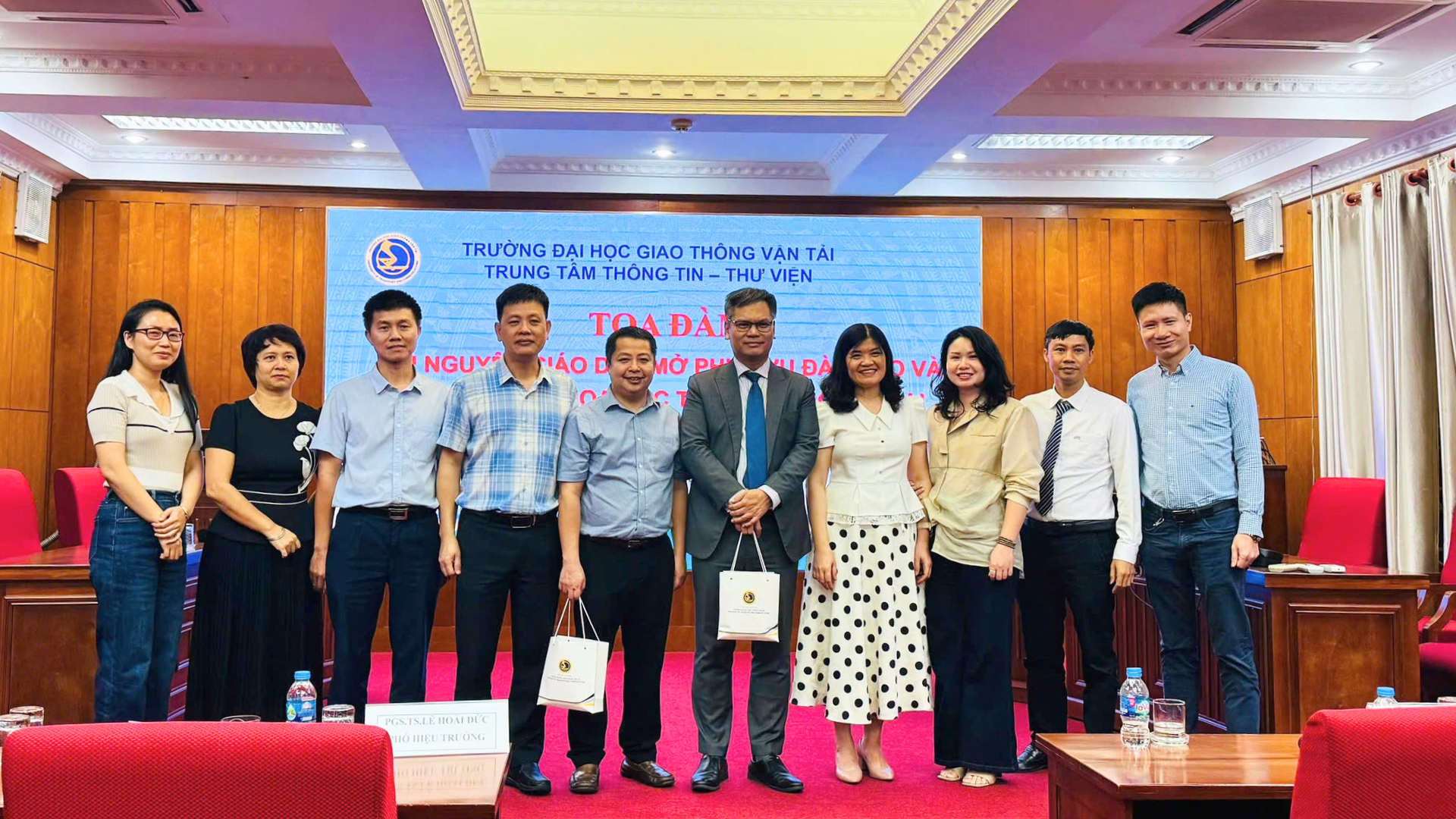
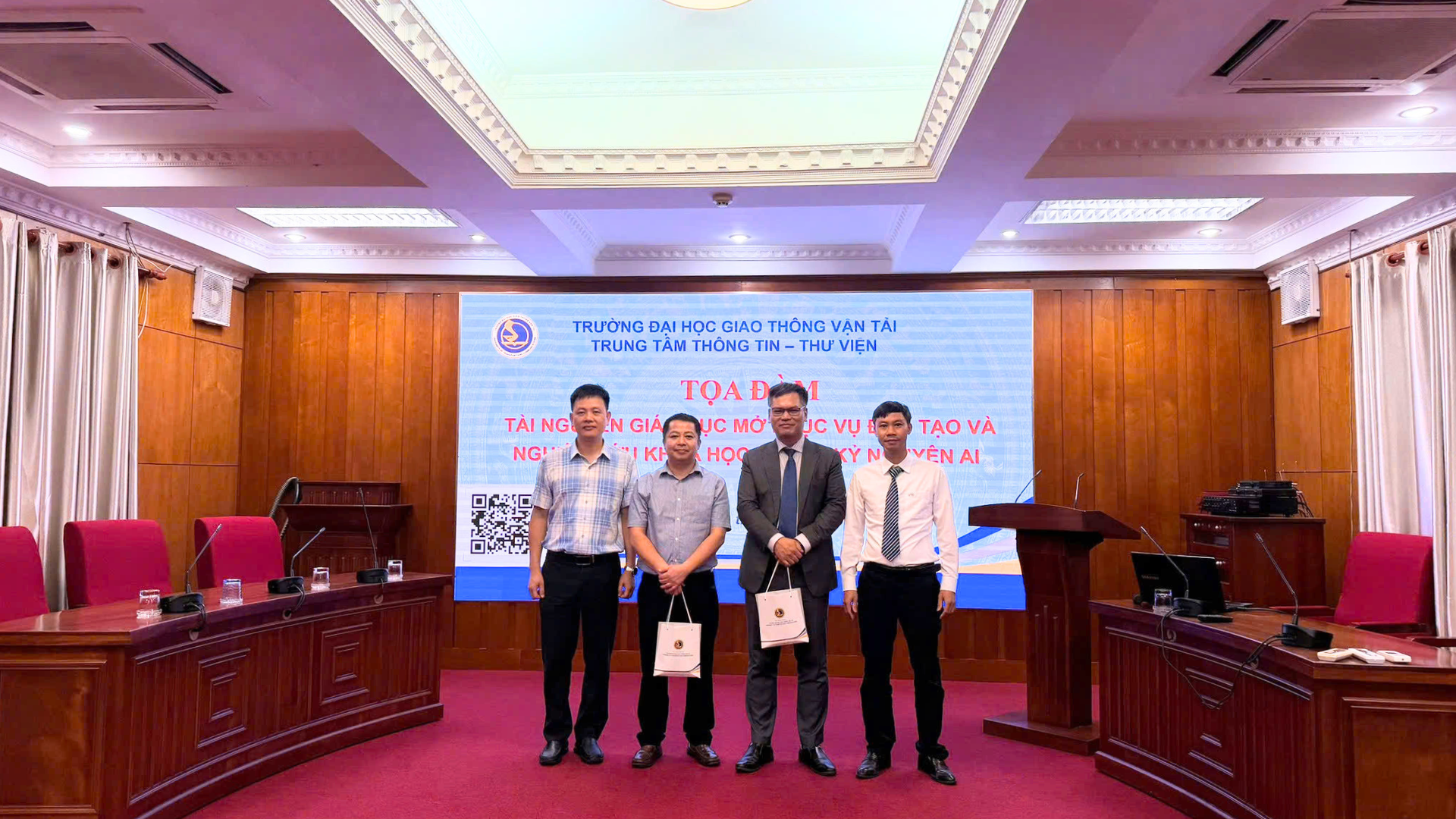
In celebration of Vietnam Book and Reading Culture Day (21/4) and World Book and Copyright Day (23/4), on the morning of April 23, 2026, the University of Transport and Communications (UTC) organized a seminar themed “Open Educational Resources for Training and Scientific Research in the AI Era”. The event brought together university leaders, experts, lecturers, and a large number of students to discuss the role of open knowledge and AI amidst the rapid transformation of higher education.
Vietnam Foundation’s perspective: OER is the foundation, AI is the driving force
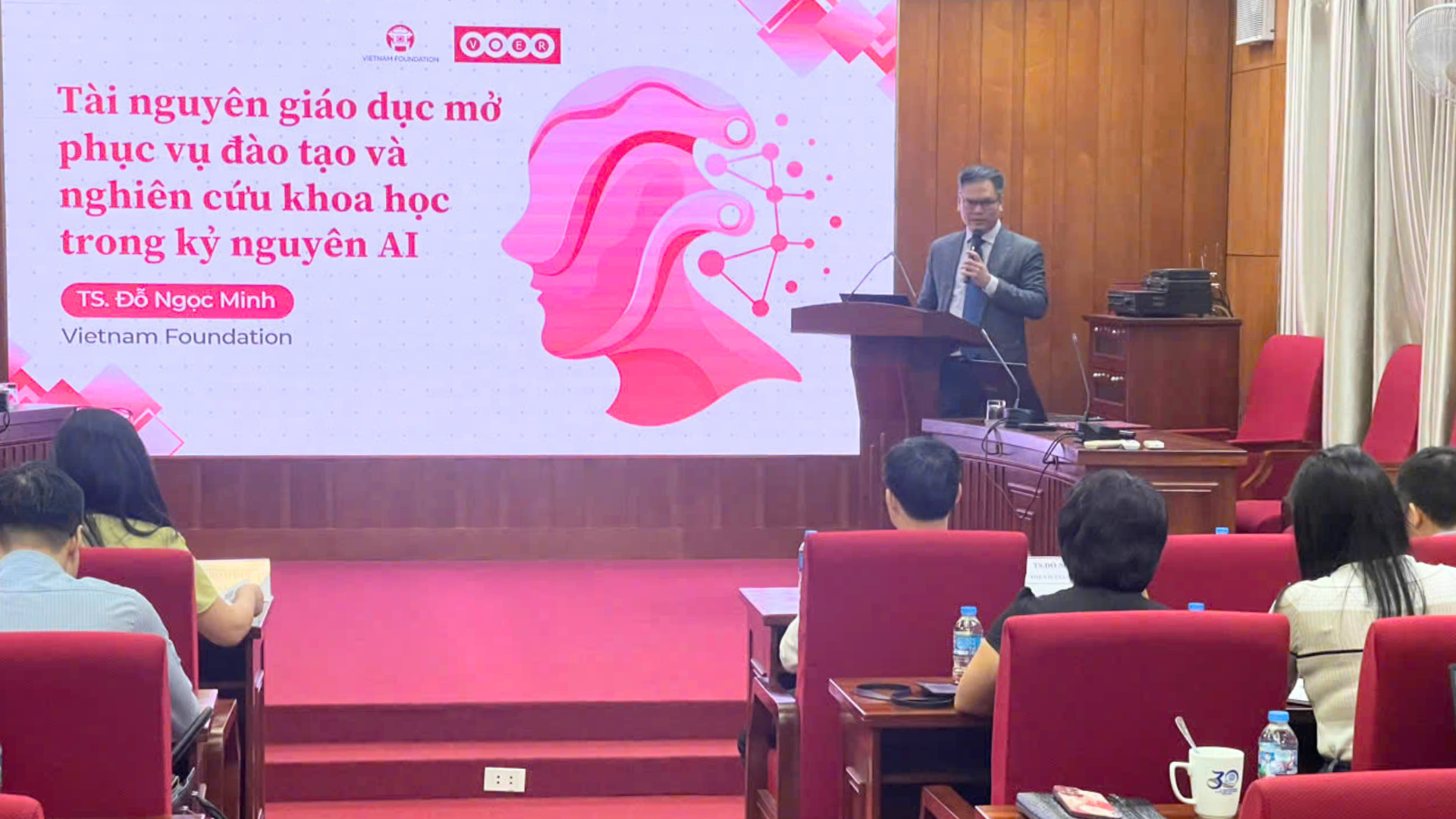
At the seminar, Mr Do Ngoc Minh – Director of the Vietnam Open Educational Resources (VOER) Program and Co-founder of the Khan Academy Vietnam Program under the Vietnam Foundation (VNF) – delivered a presentation on open educational resources (OER) in the age of AI. Having been involved with the open courseware movement since its early days – when he served as Director of the Vietnam Education Foundation (VEF), the Ministry of Education and Training, VASC, with two international partners, Connexions Rice and MIT OpenCourseWare, starting in 2005 – Mr Minh brought to the seminar a systematic and highly practical perspective regarding the two-decade journey of open knowledge development in Vietnam. According to Mr Minh, open knowledge is not a new trend but rather the result of a long journey: from Project Gutenberg, MIT OpenCourseWare, UNESCO OER, and Connexions-OpenStax, to the emergence of Creative Commons and learning platforms like Khan Academy. The key point to emphasize is that OER is not just free materials, but knowledge that can be reused, revised, remixed, and redistributed based on clear open licenses, which is a crucial factor in making OER a high-quality input data source for AI.
“OER is the open knowledge foundation, AI is the tool to exploit and amplify that knowledge – and universities are being restructured around these two factors.” Mr. Do Ngoc Minh
From sharing learning materials to innovating teaching, learning, and research methods
The presentation highlighted the increasingly close relationship between OER and AI. The Khanmigo platform, developed through a partnership between OpenAI and Khan Academy, is unlocking an entirely new approach to teaching and learning; meanwhile, Google’s integration of OpenStax content into Gemini demonstrates that OER is increasingly becoming a vital knowledge source for AI systems. Notably, Khanmigo in Vietnamese has now been deployed for teachers in Vietnam, serving as concrete proof that the convergence of OER and AI is happening right here in Vietnam, rather than being a thing in imagination.
This combination yields highly practical benefits: teachers can easily and flexibly create and customize open educational materials, while OER ensures the quality and transparency of the input data for AI. As a result, students can experience more personalized learning and take greater initiative in their exploration and research processes.
OER can also serve as a starting point for academic research: beginning with the initial sharing of learning materials, gradually developing into specialized topics, and ultimately advancing toward the publication of scientific research results. Mr Minh called on the community of lecturers and learners to view AI and OER not merely as support tools but as a foundation that unlocks unprecedented capacities for self-learning and independent research, enabling every individual to proactively discover, build, and publish their own knowledge.
Spreading knowledge from schools to the community
The seminar also clarified many practical issues: copyright in the digital environment, the construction of smart libraries, and the development of open knowledge ecosystems within universities. These discussions showed that for OER to be truly effective, it requires the joint efforts of schools, teachers, social organizations, and the learning community.
Through its participation in the seminar, Vietnam Foundation continues to affirm its pioneering role in promoting open educational resources in Vietnam. From the early days of VOCW in 2005 to VOER today, and from Khan Academy Vietnam to open school and open class models, VNF has been accompanying schools on their digital transformation journey, bridging the educational gap, and promoting the responsible application of technology.
VNF will continue to act as a bridge connecting global knowledge with learning needs in Vietnam, contributing to the development of an open, flexible, and sustainable education system in the AI era.
Bài viết liên quan
PACCOM and Vietnam Foundation Promote Digital Education in Border-Area Schools
On March 6 in Hanoi, the People’s Aid Coordinating Committee (PACCOM) and the Vietnam Foundation...
Apr
Returning Home to Give Back – Part 2: Light from the Heart
While living and working abroad, Mr. Kien has remained deeply concerned by the reality that...
Jan
The Vietnam Foundation launches the Vietnamese version of Khanmigo – an AI-powered teaching assistant free for teachers nationwide
In recent years, the integration of artificial intelligence (AI) into learning has reshaped the global...
Dec
The bridge builder of education between Vietnam and the world
From his own journey, Mr. Kien Pham (Vietnamese American) deeply understands the transformative power of...
Oct
Vietnam Foundation and Department of Science, Technology, Information share a common vision on the teacher’s role in the AI-driven education
Artificial intelligence (AI) is rapidly advancing and exerting a profound influence across all sectors, and...
Sep
Vietnam ready to implement AI in education – time to choose the right tools
Vietnam is showing strong determination in applying artificial intelligence (AI) to education. With large-scale training...
Sep